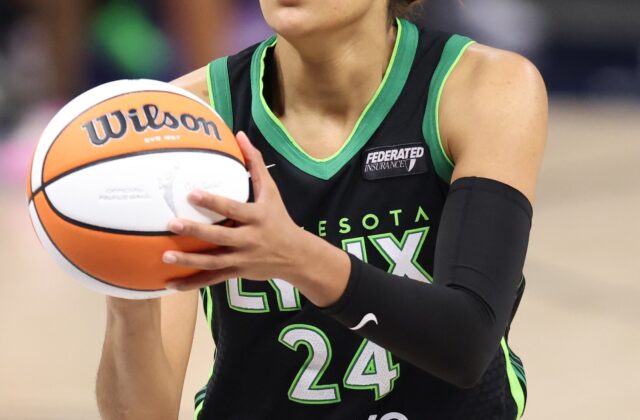
A’ja Wilson’s Place in MVP History Is a Betting Signal, Not a Trivia Answer


Photo by John Mac — CC BY-SA 2.0 via Wikimedia Commons
Every so often a piece of content surfaces that looks like a history lesson and functions as a handicapping tool. The running list of WNBA MVP winners — now headlined by A’ja Wilson’s record-setting collection of trophies — is exactly that. If you bet WNBA futures, this list is not nostalgia. It is a nearly three-decade dataset on how voters behave, which player profiles get rewarded, and which team contexts produce winners. That is actionable information in a market that remains far less efficient than its NBA counterpart.
The reason this matters to your bankroll is simple: MVP futures in the WNBA are soft. Liquidity is thin, books shade toward name recognition, and pricing often lags the underlying predictive variables by weeks. Bettors who understand the historical shape of the award can build a candidate pool before the market catches up — and that edge compounds over a season.

Repeat Winners Are the Market’s Blind Spot
Scan the honor roll and one pattern jumps out immediately. Wilson has now won the award four times. Lisa Leslie, Lauren Jackson, and Sheryl Swoopes each won three. Breanna Stewart and Candace Parker won two apiece. By my count, roughly half of all MVP awards handed out since 1997 have gone to players who had already won at least once. The award is structurally dynastic.
Yet every season, the same narrative resurfaces: voter fatigue will block the incumbent. The historical record says otherwise. Voters do not appear to get bored — they get anchored. Once a player establishes herself as the league’s best, the burden of proof shifts to the challenger, who typically needs a clearly superior statistical season and a comparable team record to pry the award loose. For bettors, this means the market’s recurring discount on repeat candidates is often a mispricing, not a risk. When a proven winner opens the season on a contender, her MVP price deserves more respect than the fatigue narrative suggests.
Team Record Is the Real Gatekeeper
The second pattern is even more predictive: MVP winners almost never come from middling teams. The award functions less like an individual honor and more like a trophy for the best player on a top-two or top-three seed. Wilson’s wins with the Aces, Stewart’s with Seattle and New York, Jackson’s with Seattle — the throughline is elite team performance, not just individual dominance.
The practical implication is that betting MVP futures is really betting team futures in disguise. Before you evaluate any player’s stat line, filter the field by projected standings. A superstar on a rebuilding roster can post historic usage numbers and still finish outside the top three in voting. Conversely, the best player on the preseason title favorite should be near the top of your card even if her raw numbers project slightly below a volume scorer on a weaker team. This single filter eliminates most of the board before the season tips.
Do Not Confuse MVP With a Championship Correlation
Here is where the history lesson cuts the other way. Bettors routinely overweight MVP form when pricing playoff futures, assuming the league’s best player drags her team to the title. The data does not cooperate. Since 1997, the MVP’s team has won the championship in only roughly a third of seasons — and that includes stretches where one dynasty, like the early Comets or the recent Aces, skews the sample upward.
Wilson’s own career illustrates the point. She has stacked MVPs in seasons that ended in parades and in seasons that ended in early exits. The award tells you who dominated 40-plus regular-season games; it tells you far less about playoff matchups, health in September, or single-elimination variance in the early rounds. When an MVP announcement lands during the postseason, the public tends to pile onto her team. That is frequently a spot to look the other way, particularly in a series priced tight against an opponent with comparable efficiency metrics.
Building the Next Season’s Candidate Pool
The correct process, distilled from 29 years of voting behavior: start with the three or four teams most likely to finish near the top of the standings, identify the highest-usage star on each, then weight toward players with prior MVP equity. Bigs have historically dominated the award, so frontcourt players with defensive counting stats deserve a bump over perimeter scorers with flashier per-game numbers.
Wilson’s reign will end eventually, and the market will likely overreact when it does — either by writing her off too early or by crowning a successor before the team success component is confirmed. History says the patient bettor wins both trades. The MVP list is not a museum exhibit. It is a model, hiding in plain sight.
Reporting source: Who has won WNBA MVP? Wilson, Stewart, Parker, Leslie, more