Nigeria’s 55-Point Send-Off Is a Recency-Bias Trap for Futures Bettors

Photo by U.S. Air Force photo by Tech. Sgt. Samuel Morse /Released — Public domain via Wikimedia Commons
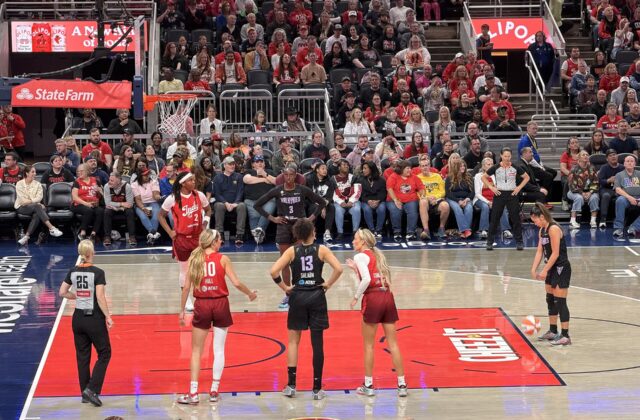
The lasting image of Nigeria at this FIBA Women’s World Cup is a 111-56 loss to France, and that image is precisely the problem. When D’Tigress next appear in a betting market — AfroBasket, Olympic qualifying, the next World Cup cycle — public perception will be anchored to a 55-point defeat, and anchoring to a single outlier result is one of the most reliable ways to misprice a team. The edge here belongs to bettors who treat this three-game sample as a dataset to be cleaned rather than a story to be remembered.
Dead Rubbers Produce Garbage Data
Context first: Nigeria arrived at the France game 0-2, their margin for error gone, facing one of the deepest rosters in world basketball at the tail end of a compressed group schedule. Whether or not elimination was mathematically sealed at tip-off, this was functionally a dead-rubber environment, and dead rubbers are among the least informative data points international basketball produces. Motivation and energy asymmetry warp everything — one side rotating with a medal push in mind, the other playing out the string on a short bench.

This is not a Nigeria-specific lesson. It is a pricing principle. In short, low-sample tournaments, game state must be part of any rating adjustment. Winless teams in final group games underperform their true level with remarkable consistency. Strip that France result out, or at minimum discount it heavily, and Nigeria’s tournament looks materially different from the headline number.
What the Cleaned Sample Actually Shows
Nigeria’s three margins of defeat: 18, 4, and 55. The mean — roughly 26 points — is dragged upward by one outlier and describes a team that never actually took the floor. The Hungary game, a 71-67 loss contested into the closing possessions, is the most representative performance of the three. That is a team competitive with a mid-tier European program, not one being lapped by the field.
The totals picture is equally instructive. Nigeria’s three games produced 180, 138, and 167 combined points — a 42-point spread between high and low. That variance was driven almost entirely by opponent identity and tempo rather than anything intrinsic to Nigeria. For totals bettors, the takeaway is that “Nigeria games” are not a coherent category. Any model treating them as a consistent over or under team across matchups is mis-specified; the opponent’s pace profile does the heavy lifting.
Offensively, the scoring decline across the tournament — 81 against South Korea, 67 against Hungary, 56 against France — tracks escalating defensive quality and, in the finale, evaporating incentive. That 81-point outing matters. It establishes a functional scoring ceiling that a single blowout cannot erase from the record.
“Weren’t There Yet” Is a Signal, Not a Surrender
Rena Wakama’s post-elimination framing — that Nigeria “weren’t there yet” — reads as an honest audit, and for futures purposes it should be interpreted as a program still travelling upward. This is a side that has dominated African competition for years and, at Paris 2024, became the first African team to reach an Olympic basketball quarterfinal. A winless World Cup is a floor event within that trajectory, not a reversal of it. Coaching continuity under Wakama raises the program’s baseline from cycle to cycle, and stability is one of the strongest predictors of improvement in the international game.
Amy Okonkwo remains the frontcourt centerpiece, and the widening pipeline of Nigerian players with WNBA exposure keeps the talent floor climbing. For player-level markets in future tournaments, Okonkwo’s usage in a thin rotation makes her one of the more dependable volume profiles on the roster — the kind of bet that holds value even when team results swing violently from game to game.
How to Price D’Tigress From Here
The framework is straightforward. Weight the Hungary performance as the truest current rating. Discount France as a dead-rubber artifact. In African competition, treat Nigeria as the class of the field until actual results say otherwise — their continental dominance has been sustained long enough to earn that prior. In global events, treat them as a high-variance underdog best approached live rather than pregame, where in-game volatility can be traded instead of merely endured. And monitor roster announcements closely: for a program whose ceiling depends heavily on which WNBA-linked players suit up, squad news moves true ratings more than anything that happened this week.
The market’s memory of this World Cup will be 111-56. The database says 71-67. Price the body of work.
Reporting source: Nigeria 'weren't there yet' after FIBA Women's World Cup exit – Rena Wakama